

Passionate and highly knowledgable instructors, useful tools
| Negotiation Skills Training for Sales and Procurement |  |
| Discover how organizations can enhance their negotiation training skills to increase their sales revenue and drive down procurement costs. |
Negotiation Skills Training Opportunity
Organisations are continually trying to find ways to enhance sales revenues and sales margins while reducing procurement costs in the process. One question often raised is:
"How can skills training be developed to achieve these bottom line objectives?"
The primary objectives that are achieved by any organization can be characterised by communications with colleagues, suppliers, customers, shareholders and other stakeholders. The reality is that individuals can no longer decide whether they would like to negotiate in sales or procurement, they can only decide only how well they would like to negotiate.
One of the most available and powerful means that can accelerate the realization of your organisational growth objectives is to enhance your organisation's negotiation skills efforts.
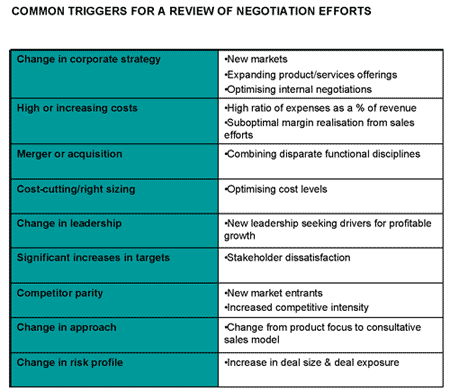
Why start with Sales & Procurement Teams?
The impact of negotiation skills courses for buyers and negotiation courses for sales departments can be measured within weeks of the negotiation training. When the training investment is measured against the cost of the program, the ROI clients typically enjoy after our 3 to 4 day programs is in excess of 10 times in the first 6 to 12 months. The bottom line profit impact can be single to double digit over the course of a year. The organisation challenge then becomes how to attain profitable sales revenue growth while maintaining a tight grip on expenses through quick cost improvements via procurement and then operations.
Many organisations understand that the established growth tactics which utilized practices such as play sales, marketing and purchasing training have simply "run out of steam". This has occurred in large part due to the era of 'best practice standardisation'. Just as manufacturing organisations have embraced the carrying out of proven best practices, so organisations across the board have utilized best practices in two key areas:
- Sales environment - typically through the creation of a sales strategy that uses a formal sales methodology
- Procurement or Purchasing environment - typically through supply chain optimisation, strategic sourcing and supplier management initiatives
The effect has been to level out the playing field with most organisations that deploy sales and purchasing strategies and processes that are similar in nature and design.
To attain a higher revenue & margin growth in a standardised market environment necessitates our taking an innovative approach. If utilized effectively, Negotiation Training will act as a catalyst to stimulate the a leveraged competitive advantage.
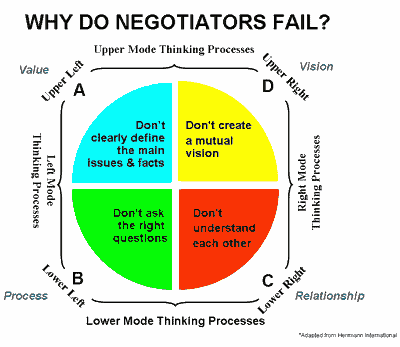
Before we examine the best ways to use negotiation training to increase our return for both sales and procurement departments, it is useful to consider the reasons why negotiators often fail to achieve the best results from their buying and selling negotiation efforts.
BUSINESS NEGOTIATIONS
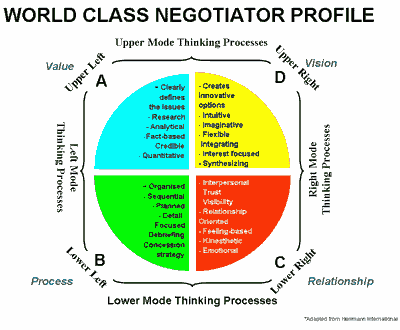
Generally speaking, sales and procurement negotiators fail because they don't negotiate in a 'whole brain' way. Research has shown that our actions and communications will be most effective when they are used in a holistic, whole brain way. In sales and procurement business negotiations, this means that negotiators must steer their actions ad communication skills effectively by concentrating on four core areas of negotiation:
1. Value
Business negotiators must make certain that they have an astute understanding of the facts as the basis for both sales and procurement negotiations. Failure to gather & understand the relevant facts that support optimal deal making will result in a failed negotiation or negotiations where value or resources are left on the table.
2. Process
Any procurement or sales negotiation that does possess a vigorously defined negotiation process and lacks a management infrastructure runs the risk of a sub-standard outcome. A skills framework to operate in is necessary so that it can provide an environment where risks can be pro-actively managed. A robust negotiation process guarantees a positive momentum and offers al framework of reference that lessens unforeseen complications & risks.
3. Relationship
Contract agreements can only be completed between sales and procurement departments that are represented by skilled people. It goes without saying that the manner in how we interact with other people is the essential basis for a successful negotiation. Within a procurement-sales negotiation context, the importance of relationships is amplified when we find ourselves in an environment where ongoing partnerships and long standing relationships results from our business deals together.
4. Vision
To achieve a collaborative or partnership agreement, it is necessary that all parties have a shared vision of the losses and benefits associated with the agreement. It is only when both buyers and sellers have a shared vision of the agreement that we can understand their driving motivators or interests. A crucial part of negotiation competency entails the ability to create options that will serve the needs & interests of sales and procurement negotiators and of course their companies.
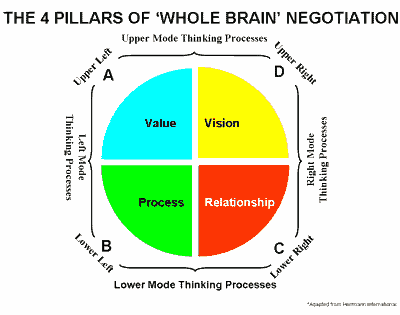
World class negotiators expand their skills & competencies in each of the 4 main areas. This empowers negotiators and allows them to deal competently in areas that would normally fall outside of their natural areas of 'preference'.
NEGOTIATION SKILLS TRAINING
Successful negotiation skills training can be implemented in two ways:
- Generic leading practice based (off the shelf)
- In-house training
- Public access format for open course training
- Vertical & customised (suited to industry & organisational specific challenges, needs & strengths)
- Sales Skills Negotiation in-house training with customised sales case studies
- Procurement Skills Negotiation in-house training with customised sales case studies
- Advanced Negotiation in-house training for Executives and Senior Management
The most effective negotiation skills training participation will be determined first by the defining and/or designing a negotiation strategy and supporting process, tool-sets and techniques taught. This will secure the creation of a negotiation capability at an organisational level. The outcome will be to successfully equip the organisation with a key competency in negotiation, and this will result in competitive differentiation in sales, procurement and throughout the company.
The diagram below illustrates an effective negotiation skills training flow:
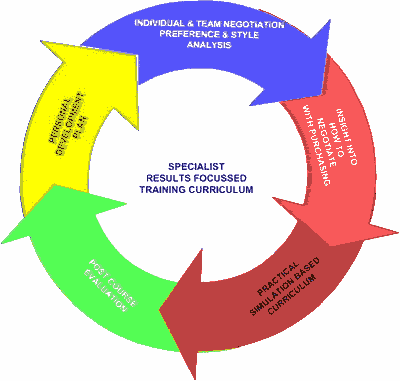
To ensure the maximum impact, sales, procurement, advanced and all other negotiation training programmes should cover the following primary areas:
- Individual negotiation preference & competency profiling.
- Negotiators must fully understand their preferences, negotiation style and negotiation competencies in the arena of business negotiations.
- A proven comprehension of strategic sourcing and the tactics or approaches taken by buyers to negotiate purchases.
- Sales negotiation training programmes should be built upon a strong foundation of how an organization operates its procurement and purchasing functions. This is a crucial element which will make certain that sales negotiators are equipped with the skills to apply 'mission specific' sales negotiation strategies & tactics.
- Provide negotiators with practical simulations within which to learn & deploy negotiation skills.
- Research has shown that learning is hastened by a practical learning environment, where for example sales and procurement case studies focus on rea life commercial challenges that closely match business reality.
- Provide negotiators with the means to demonstrate their understanding and acquisition of new negotiation skills through a post course assessment.
- Too many training courses don't realize their objectives because they don't provide a post course assessment environment that encourages negotiators the ability to examine the negotiation skills they have acquired.
- Managers work with each member of their sales, procurement or other team to devise an individual Personal Development Plan based on their demonstrated preferences, areas of challenge & competencies
- It is unlikely that one or even two negotiation training interventions will allow sufficient time for each participant to fully develop their negotiation skills. It is critically important to give each negotiator with a personal development plan that will aid them in continuing the development of their negotiation skills. Only internal management are in the unique position to watch observe their team develop, and suggest or provide coaching or mentoring.
Back to Negotiation Articles
We welcome the republication of this page's contents in part or full - we just ask that you include a clean link back to this site, to our www.negotiationtraining.com.au/training/ page.
|
Reader Comments
Average Reader Rating:
share your comment |
|
|
No comments |



Reader Comments
Average Rating:
Total Comments: 0